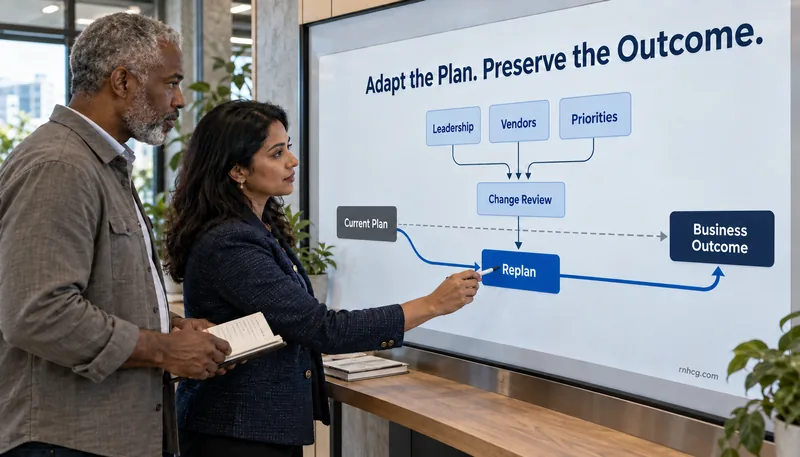
When Modernization Loses Momentum (And How to Reset It)
Modernization programs rarely fail at the technology layer; they lose momentum the moment replacement becomes the goal and the business problem leaves the room.
RNHCG
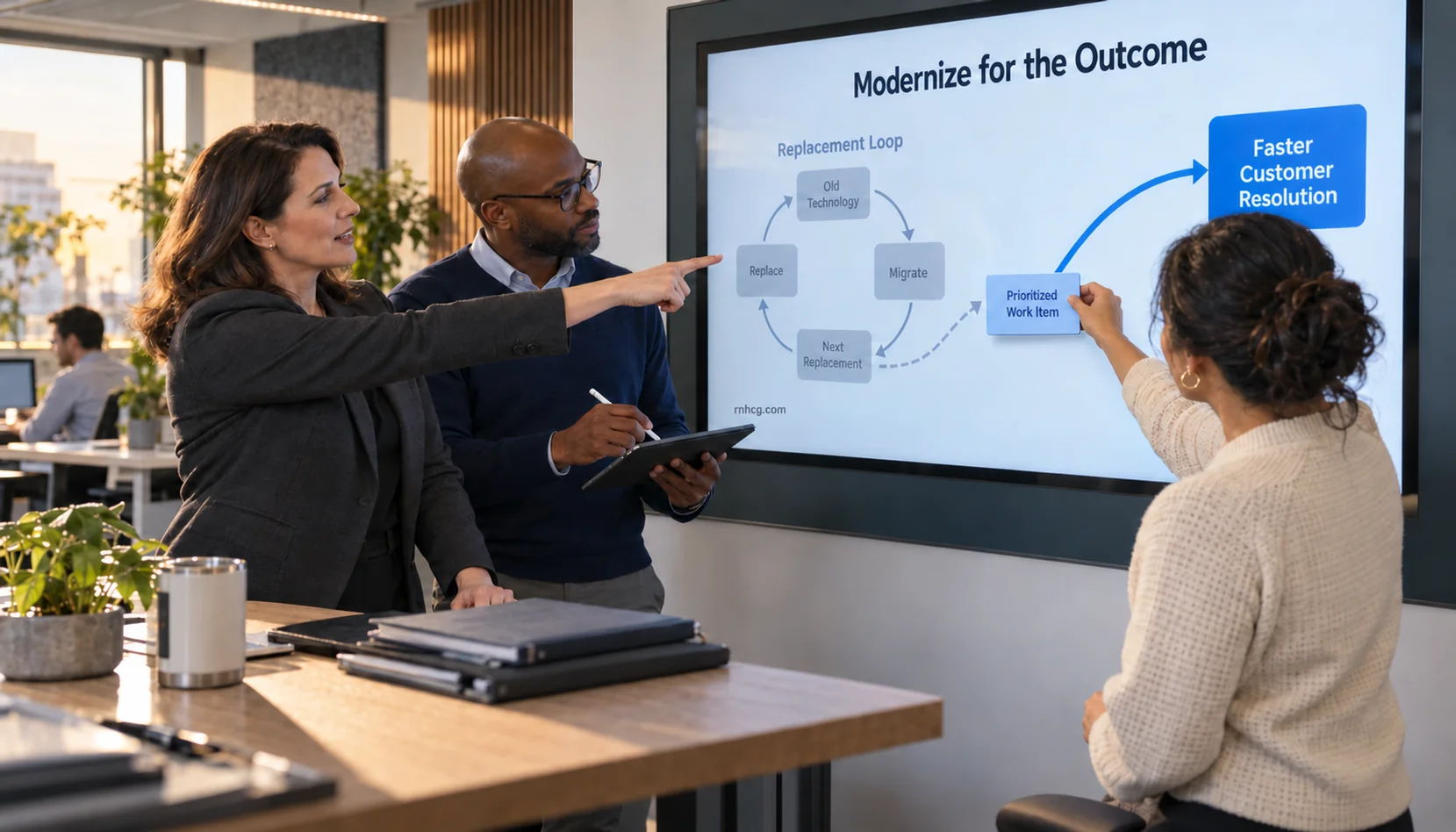

Reset the direction before accelerating the work.
A modernization program that can no longer say which business decisions will improve has already lost momentum. Resetting it starts with the definition of done, not the delivery plan.
Observation
Most modernization initiatives begin with energy and a clear enemy: the legacy system. Eighteen months later, a familiar scene has usually developed. The program is measured by migration progress. The business sponsors who championed the initiative have drifted into status-report recipients. Scope has grown as each business unit negotiated its own requirements. And somewhere along the way, the program stopped being able to answer a simple question: which business decisions or operations will actually improve when this is finished?
The system gets replaced. The problems survive the replacement.
Why Organizations Struggle
The drift is built in at the start. The business case for modernization is usually written about the technology: end-of-life platforms, vendor support ending, security exposure, rising maintenance cost. Those are real, but they hand the program a technical definition of done. A program funded to retire a system will retire a system. Nothing in its charter requires the business to work differently afterward.
Funding follows the same shape. Money arrives for the replacement, not for redesigning the processes, decision rights, and operating model the old system quietly encoded. Governance then oversees delivery milestones rather than decision quality, so the program can be perfectly on schedule while steadily losing its purpose. Meanwhile, sequencing decisions get made by whichever stakeholder argues loudest, because no shared business priority exists to arbitrate.
“The system gets replaced. The problems survive the replacement.”
What Experienced Leaders Discover
Leaders who have carried several of these programs learn to spot the moment of drift early, and it is not a missed milestone. It is the moment the program can no longer state, in plain business language, what will improve and for whom. When the honest answer becomes some version of like-for-like plus cleanup, the initiative has already lost momentum, whatever the burn-down chart says.
They also learn that the oldest system is not automatically the first to modernize. Programs keep direction when execution is sequenced by business exposure: which system's failure or rigidity is costing the most, and which change clears the path for the next one. A legacy application is not just code to replace. It is a record of business decisions, many of them forgotten, that deserve to be re-examined rather than faithfully re-implemented.
Practical Implications
Before funding the next modernization initiative, and especially when resetting one already in flight, a few things deserve pressure-testing that have nothing to do with the target platform:
How RNHCG Helps
When an initiative needs an independent read before more budget is committed, an Enterprise Transformation Assessment provides the honest current-state diagnosis, and an Enterprise Transformation Roadmap turns that diagnosis into a plan sequenced by business priority with a governance model built to keep it pointed at outcomes.